14 ways to pass 4 hours of chemo without your phone.
A practical, real-patient-tested guide to what to actually do with infusion-chair time when the phone runs out, the eyes get tired, and the doom-scroll fatigue hits at hour two. Sourced from breastcancer.org community discussions, r/cancer threads, oncology-nurse interviews, and consistent themes from long-treatment patients across multiple regimens.
1. Audiobooks (the most-recommended)
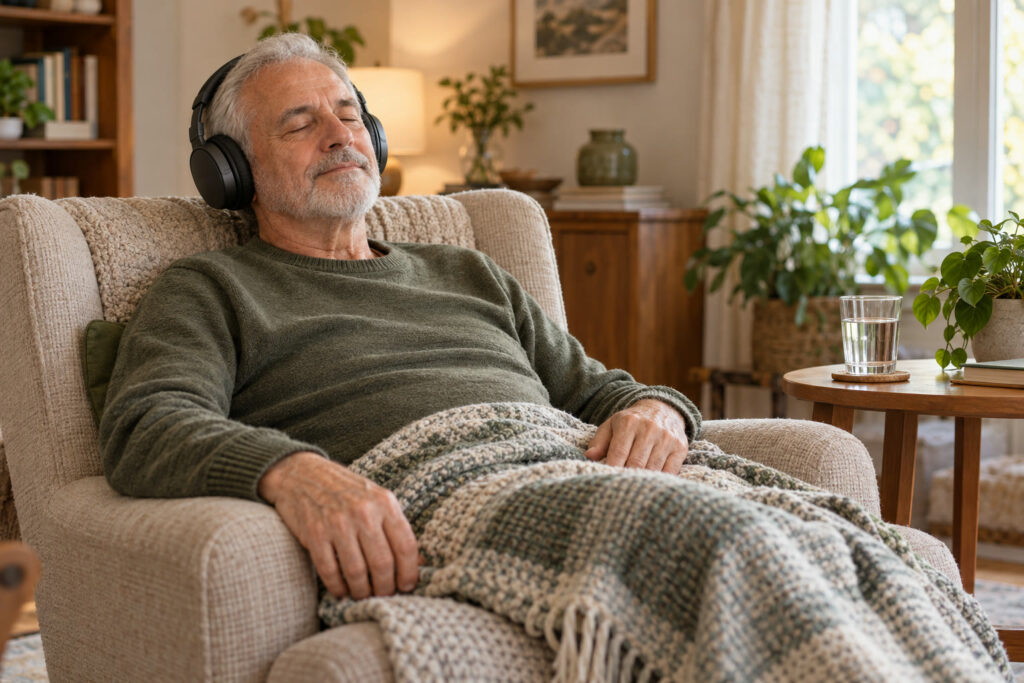
The single most-cited chair-time activity. Eyes can close. Hands stay free for ice chips, water, the occasional nurse interruption. Length matters — pick something that runs 4-8 hours so you finish during a treatment cycle and have a small accomplishment that maps to the medical timeline. Recommended formats from real patients: literary memoir without a tragic arc, nature writing, comedy from comedians you already trust, and good travel writing. One specific note: avoid medical memoir during active treatment. Reading about other people’s cancer while you have cancer is rarely the comfort it sounds like.
Audible, Libby (free through public libraries), and Spotify Audiobooks all work. Download before you leave home — clinic Wi-Fi is unreliable and you don’t want to discover that at hour 3. Set a sleep timer if you might nap; the audiobook auto-pauses and you don’t lose your place.
2. Adult coloring books with quality markers
Sounds twee. Isn’t. The repetitive motion of coloring activates the same calming response as guided meditation, without the meditation effort. Real patients describe surprise at how much it helps — including patients who said they’d never do this. Pick a book with patterns you actually like (mandala, botanical, stained glass, architectural), not “stress relief” themed books that lean self-help. Bring real markers — Tombow Dual Brush or Stabilo are favorites; cheap markers bleed and frustrate. Set the book on the chair tray. Single-arm-friendly: if the IV is in your dominant hand, you color with the non-IV hand and discover that the result is fine.
3. A stack of magazines you’ve never read
The magazine subscriptions that pile up unread at home — New Yorker, Atlantic, Cook’s Illustrated, House & Garden, Architectural Digest, National Geographic — are perfect chair-time reading. Bring three. Read one article. Put it down. Read another from a different magazine. The browse-friendly format suits the chair in a way that books don’t: you don’t have to track a plot, you can stop and start, and the physical pages are different from your phone in a way your eyes will thank you for. Library and friends are the cheapest sources. Don’t recycle the unread pile — bring it.
4. A paper crossword or Sudoku book
Specifically paper, not the phone app. Different cognitive engagement and a different relationship with time. The pencil-and-eraser ritual is part of the point. NYT Sunday crosswords are a meaningful chunk of one infusion. Will Shortz Sudoku books run from “easy on the way in” to “fierce by hour 3.” Many patients describe a personal ritual of completing one Sudoku per cycle — small countdown-style accomplishments that map to the medical countdown.
Other paper-puzzle options worth trying: cryptic crosswords (UK-style; high engagement), logic puzzles (Penny Press), KenKen, Numbrix, hidden-picture books, even kids’ Highlights magazines (no shame; the brain rest is the point).
5. Letter-writing
The least-suggested option that recurs as the most-meaningful when patients reflect afterward. Pick a person — an old friend, a distant cousin, your kid’s future-self, someone who’s been kind during treatment, an old teacher. Write them a real letter. Pen, paper, envelope, stamp. Mail it that week. Some patients describe the letters they wrote during chemo as the writing they’re proudest of in their lives. The chair-time forces a slower thought process; the letter benefits. Tip: bring a few stamps and pre-addressed envelopes so the only friction is the words. Write a letter to your future self if no one specific comes to mind — open it on the one-year-after-treatment anniversary.
6. A small sketchbook and a pencil
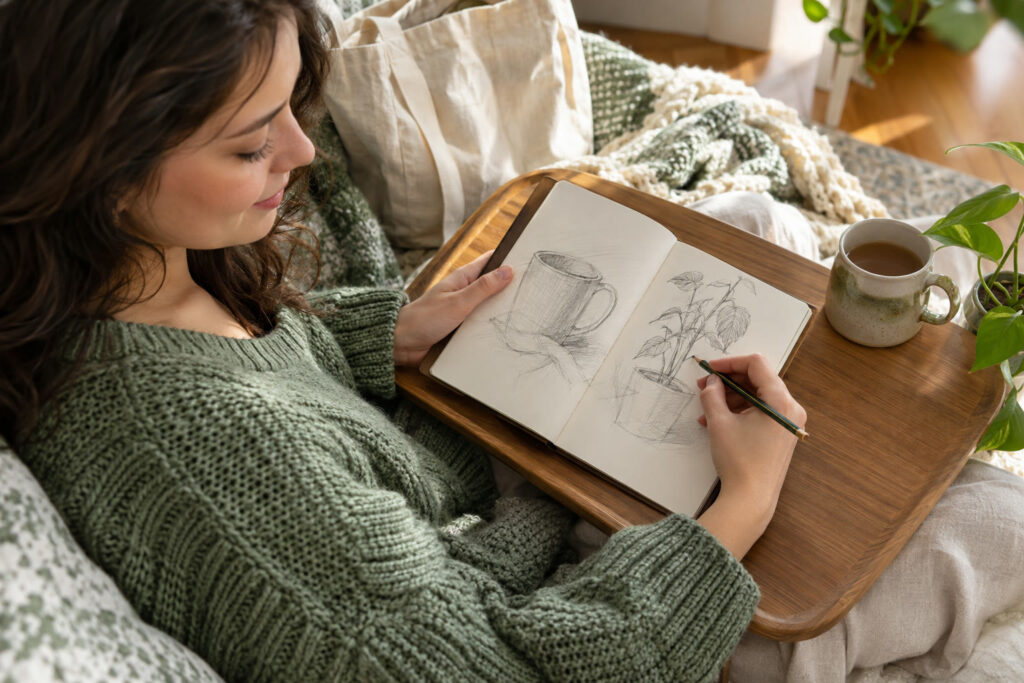
You don’t have to know how to draw. A 5×7 sketchbook and a 2B pencil. Draw the IV stand. Draw the corner of the room. Draw your hand. The point isn’t the drawing; it’s the way looking-and-recording shifts attention onto the present, away from the medical anxiety, away from the timeline. Many patients pick up sketching during treatment specifically and describe the resulting sketchbooks as the most-treasured artifact of the year. If pencils feel too committed, watercolor pencils (Caran d’Ache, Faber-Castell) bridge sketching and painting and need only a small water cup.
7. Deliberate sleep
The most underrated option. Eye mask, earbuds with white noise or low ambient music (Brian Eno’s Music for Airports is a favorite), small neck pillow, the tablet on do-not-disturb. Aim for 60-90 minutes mid-infusion. The combination of pre-medications, the infusion itself, and post-treatment fatigue means most patients are running on real sleep deficit; planned chair-naps recover ground that home-sleep can’t quite reach. Don’t fight the urge to sleep; treat it as part of treatment. Tell the nurse your plan so they don’t read your eyes-closed silence as something to investigate.
8. Conversation prompts (with your treatment partner)
If a partner, spouse, parent, or close friend is in the chair next to you for the full 4 hours, the natural conversation runs out by hour two. Most chair-side companions then default to silent eyes-on-phone parallel play, which is fine but is not what you came for. Bring a small set of conversation prompts. You can buy card decks (Vertellis, We’re Not Really Strangers, Estate3) or make your own on index cards. Prompts that work: “What’s a memory from your childhood you’ve never told me,” “If we could move anywhere right now, where,” “What were you afraid of at twenty-five,” “What would you do if you had a free Saturday,” “Who do you miss.” Treat the chair-time as a forced-quality time gift. The conversations real chair-partners describe from chemo days are often better than any conversation in their actual lives.
9. Gentle in-chair stretches (PT-cleared)
Sitting still for 4 hours stiffens everything. A small stretching routine — neck rolls, shoulder rolls, gentle ankle circles, gentle hand and foot squeezes — keeps blood circulating and reduces the post-infusion stiffness that catches up with you the next day. Avoid anything that pulls on the IV-arm. Many infusion clinics have a printed “in-chair stretches” handout; ask the nurse. If you have neuropathy, hand and foot squeezes are particularly worth doing each hour.
10. A small album of family photos
An actual physical photo album or printed booklet of 30-50 family photos. Sounds quaint. Real patients describe it as a surprisingly grounding chair-time activity. Slowly turning pages, recognizing your own life from outside the chair, calling specific people to mind. Different from scrolling photos on the phone in a way that’s hard to articulate but easy to feel. Make one before treatment starts; bring it every cycle.
11. List-making (for life after)
Bring a notebook. Make lists. Books to read after treatment ends. Trips to take when energy returns. Restaurants to revisit. Old friends to reach out to. Recipes to try. Plants to put in next spring. Garden plans. Career questions to think about. The list-making is the point — it shifts your imagination forward into a future where treatment is over, which is a useful mental motion at hour three of cycle six. Some patients describe the lists they made during chemo as the blueprints for the post-treatment year.
12. Knitting, crochet, or simple needlework (if your hands tolerate)
Caveats first: knitting requires both hands, both with fine motor control. If the IV is in your dominant hand and the operative-arm side is anatomically restricted, knitting is hard. If you have neuropathy, knitting is sometimes painful and sometimes not. With those caveats, knitters and crocheters who can do it describe the rhythmic motion as deeply soothing, and a finished baby blanket / scarf / hat at the end of treatment is a tangible artifact of the chair-time. Bamboo or wood needles (vs. metal) are quieter and warmer in the hands. Simple stitch patterns only — no chair-time for figuring out new stitches.
13. Pre-downloaded films on a tablet
The “watching shows” option, but pick films you’ve seen before. The trap with new shows is that the IV machine alarm beeps every 20 minutes, the nurse interrupts for vitals, you doze and wake mid-scene — and you lose the plot. Films you’ve already seen recover from interruptions instantly. Older comfort-watch films, beloved romantic comedies, Studio Ghibli, the Pixar back-catalog, anything where the story is the destination you already know. Download via the streaming app’s offline-download feature before leaving home; clinic Wi-Fi cannot be trusted with high-bitrate streaming.
14. Short fiction
Novellas (under 100 pages), short story collections, essays. The chair-time benefits from texts you can finish in one sitting. Recommended starting points: George Saunders’ Tenth of December, Lydia Davis short fiction, Alice Munro short stories, Ted Chiang’s Stories of Your Life and Others, James Baldwin essays. The reading rhythm — finish one, put down, rest, start another — fits the chair. Long literary novels do not; you lose the thread when interrupted, and the chair will interrupt.
What to skip
The non-phone bag, packed
A treatment-day non-phone kit usually fits in a small tote in addition to your regular chemo bag:
The kit becomes muscle memory after 2-3 cycles. The bag is the system; the system is the relief.
How to choose what to bring on each day
Most patients describe rotating activities across cycles rather than bringing everything every time. A rough pattern that works:
The recovery clothing piece
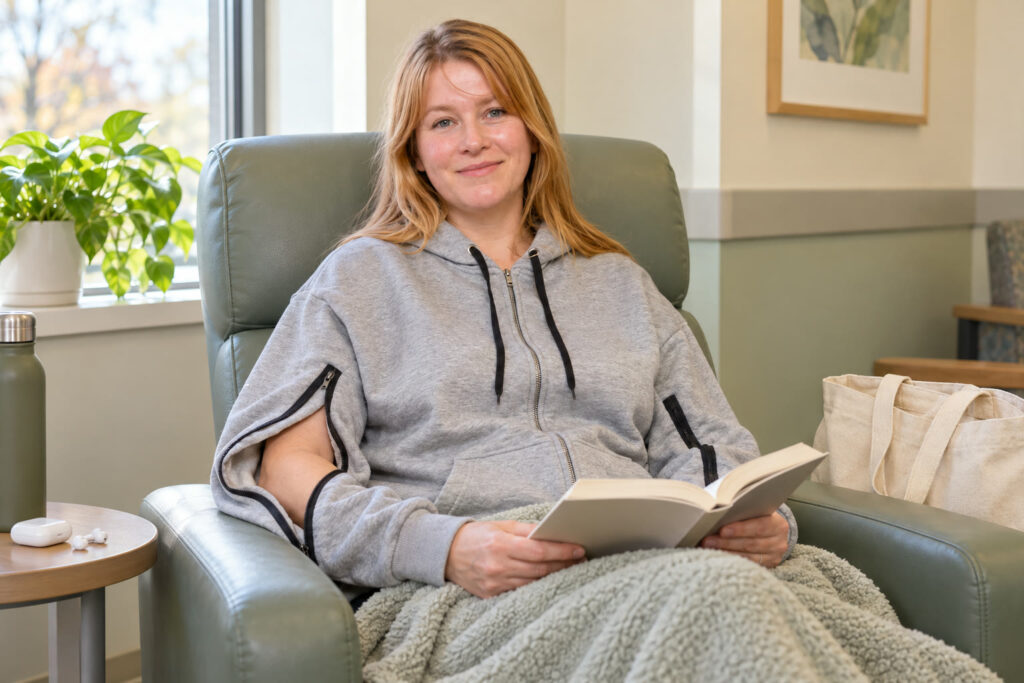
None of the activities above require special clothing — they require a comfortable chair-time setup, which the right port-access top, fleece, and pull-on pants enable. Our chemotherapy collection covers the wardrobe; the bag fills with the rest.
FAQ
Sources
- American Cancer Society — Getting Chemotherapy
- breastcancer.org community discussions — community
- r/cancer chair-time threads — subreddit
- Oncology Nursing Society — ons.org