Day 0 (discharge)
She’ll come home with drains pinned to a special vest or held in a fanny pack. She’ll be groggy. There may be tears — relief, exhaustion, or grief. Your job:
- Bring the recliner pillows you set up — she’ll sleep there for 1-2 weeks
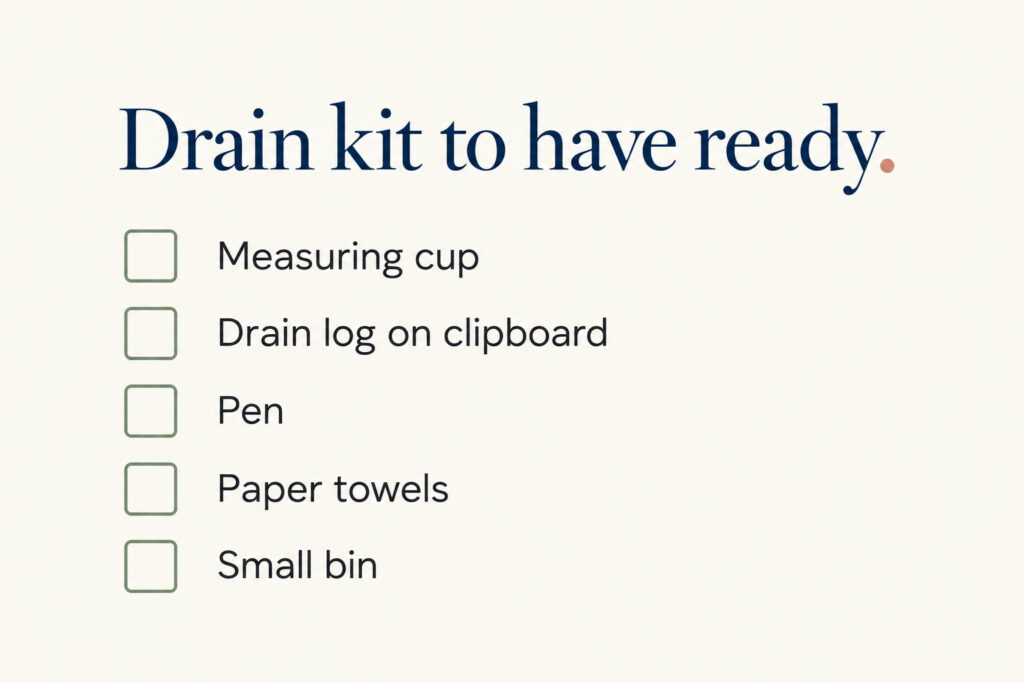
- Have a “drain kit” ready: measuring cup, drain log on clipboard, pen, paper towels, a small bin for stripping clots
- Help her change into a button-front pajama shirt
- Get the first dose of pain meds in (usually 4-6 hours post-discharge)
- Don’t have visitors. Family wants to see her — they can come tomorrow.
Days 1-3: drains, ice, and sleep
The drain routine (do this 2x daily, morning and evening):
- Wash hands
- Strip the tubing (squeeze with thumb + index, slide down the tube — see surgeon’s instructions)
- Open the bulb, pour into measuring cup
- Record amount in mL on the log (color too: red, pink, yellow)
- Squeeze bulb flat to recreate suction, close it
- Wash hands again
The drain log is what your surgeon needs to decide when drains come out. Keep it.
Pain meds: Set alarms. She’ll be too foggy to track. Stay ahead — once pain breaks through, it’s hard to catch up.
Ice: 20 min on, 20 min off, on the chest. Ice packs wrapped in cloth (never directly on skin).
Sleep: She’s in the recliner. Sit in the room when you can. Get her water, meds, snacks without being asked.
Days 4-7: showering, restocking, and emotion
Most surgeons clear shower at 48-72 hours post-op (with drains pinned to a lanyard or held in a shower bag). The first shower is hard:
- Help her undress completely
- Pin drains to a shower lanyard or use a bath-friendly drain holder
- Stay in the bathroom — she may feel faint
- Avoid wetting the incision area until surgeon says OK (usually after drain removal, ~5-14 days)
- Help dry; help into a clean button-front shirt
- Empty drain bulbs after the shower
Around day 5-6, many women describe a hard emotional moment: looking at the chest in a mirror for the first time. Don’t push it; don’t avoid it; be present without performing. “I’m here” is enough.
Days 8-14: drains come out, range of motion begins
Drain removal happens when daily output drops below 30mL/day for 2 days running (often days 7-14). She’ll have an appointment for this; drive her.
After drain removal, range-of-motion exercises start (PT-guided). She’ll be cleared for actual showers (incision can get wet). She may try to do too much. Your job: gently slow her down.
What to say (and not)
Helpful:
- “What can I do right now?”
- “I’m right here.”
- “You’re allowed to feel however you feel.”
- “How’s pain right now? Time for meds?”
Unhelpful:
- “You should be feeling better by now”
- “My friend’s wife had this and she was fine in a week”
- “The scars don’t bother me at all” (well-meaning but bypasses HER feelings)
- “At least you got through it”
- “Have you cried yet?” (let her come to it)
The 7 things husbands say they got wrong
- Trying to be cheerful when she was scared
- Filling silence with talk when she just wanted quiet
- Not setting alarms for pain meds (she missed doses)
- Inviting visitors too early
- Trying to handle reactions from extended family/work alone (she wanted to be informed)
- Pushing on intimacy too soon — or avoiding it for too long without talking
- Not asking how SHE wanted the body to be discussed (some want clinical, some want minimal, some want to ignore)
What NOT to do
Frequently Asked Questions
From the Inspired Comforts collection.


Continue reading
Sources
- American Cancer Society — Breast Cancer Treatment
- National Cancer Institute — cancer.gov
- Family Caregiver Alliance — caregiver.org